
Forest Grove City Directory Collections
The Forest Grove City Library is the main local shelf for city directories. Its History Room combines downloadable scans with later print volumes, so a search can move between a home computer and staff help without treating either route as complete. The library states that staff can look up a name or address for a person or business. That is especially useful for a year held only in print or when a scan needs careful reading. The online collection identifies the month and year of each digitized item, but it does not transcribe a publisher imprint for every scan.
| Collection | Years | Where Held | Access |
|---|---|---|---|
| Digitized Forest Grove directories | May 1926; March and September 1928; November 1934; December 1935; December 1943; October 1956 | Forest Grove City Library | Official library links |
| Supplemental telephone directory | January 1928 | Forest Grove City Library | Official library PDF link |
| History Room print volumes | 1959, 1960, 1968, 1974 | Forest Grove City Library History Room | On shelf or staff name-and-address lookup |
| Eric G. Stewart Collection item | 1964 directory material | Forest Grove City Library local-history collection | Finding aid identifies A-J and M-Z portions |
Only the 1959 volume has a documented publisher in the available research: Johnson Publishing of Loveland, Colorado. That fact should not be extended to the remaining runs. The library page is the safer authority for the digitized dates and for the fact that the collection exists.
Note: A missing year in the shelf is a collection gap, not proof that a household left Forest Grove.
Forest Grove Library Directory Shelf
The library's City Directories page is the starting point for the digitized volumes and the History Room holdings. The library is at 2114 Pacific Avenue in Forest Grove, and its phone number is 503-992-3247. History Room access fits the library schedule: Monday through Thursday, 9:30 a.m. to 7:30 p.m.; Friday and Saturday, 9:30 a.m. to 5:30 p.m.; Sunday closed. Give staff the name or address and the year you need, rather than asking them to infer a whole family story from a broad search.
The library describes possible directory fields as names, addresses, telephone numbers, occupations, and sometimes spouse names. It also notes organizational and member lists, advertising, and school, church, hospital, and business addresses. Those are collection-level possibilities. A particular local entry may contain fewer details, so record the page and heading before using it as evidence.
The official collection screen shows the local directory shelf before a reader opens a volume. Its date labels help distinguish the January 1928 supplemental telephone item from the March and September city directories that year.
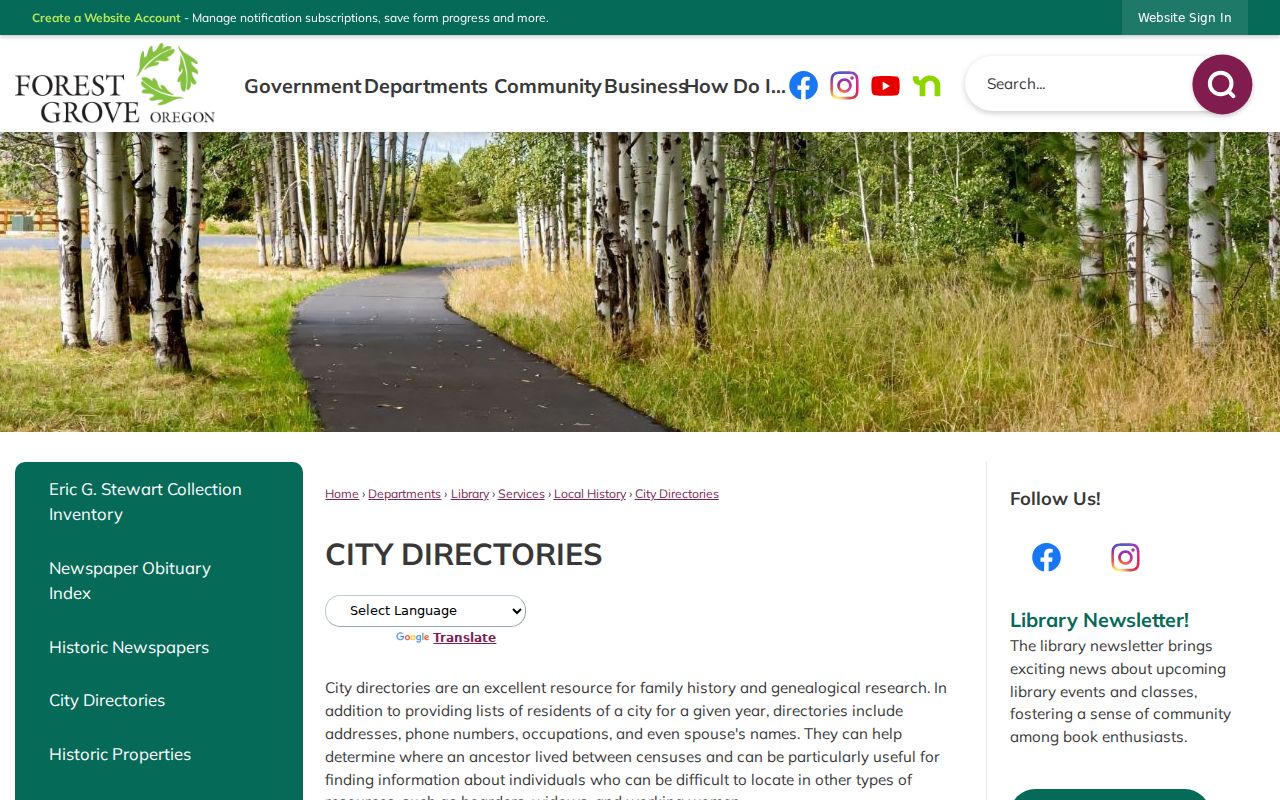
Use the screen as a collection map, then save the exact month and year with each note. A telephone book and a municipal directory may answer different questions even when they are close in date.
- May 1926: the earliest digitized directory listed by the Library.
- 1928: a January supplemental telephone directory and March and September local volumes.
- 1934 to 1943: digitized city-directory dates in November 1934, December 1935, and December 1943.
- 1956 to 1974: an October 1956 scan followed by History Room print volumes for 1959, 1960, 1968, and 1974.
The sequence shows why a directory search often requires more than one volume. The library's holdings are valuable, but they do not constitute an uninterrupted annual run.
Reading Forest Grove Directory Entries
A Forest Grove directory is best read as a dated index, not as a complete roster. Begin by copying the spelling exactly as printed. Then separate the address, telephone information, trade or occupation, and any family reference into distinct notes. The research does not safely establish a standard local abbreviation system, a generic owner or renter symbol, or a uniform spouse notation for these volumes. Inspect the target page itself or ask library staff to verify an unclear mark.
| Name | Copy the printed name and initials exactly, including a possible nickname or variant. |
|---|---|
| Address | Use it as an occupancy clue for that volume's date, then compare another source before treating it as continuous residence. |
| Telephone | Record business and home numbers separately when the item prints both. |
| Occupation or trade | Keep the wording as printed; the Library identifies occupation as a possible field, not a guaranteed one. |
| Context material | Organizations, advertisements, and institutional addresses can help identify the right local setting. |
- Criss-cross directory
- A directory arranged by address rather than alphabetically. The Library's published Forest Grove shelf does not confirm a local criss-cross run.
- Householder index
- An index that organizes entries by a household lead. Confirm that a specific volume contains one before relying on it.
- Abbreviation key
- A legend printed in some directories. No generic key is verified for these Forest Grove volumes, so read the target volume's front matter if present.
A verified 1926 telephone-directory advertisement illustrates the need to keep fields separate. It names C. A. Brodersen Paint Store, identifies the trade as painting contractor, gives 16 Pacific Avenue East, and prints distinct store and house phone numbers. It is a documented item example, not a model for every residential entry.
Forest Grove Newspaper Gaps
When two Forest Grove directory years leave a long gap, the library's historic newspaper collection can supply a dated mention. A 2017 partnership with the University of Oregon digitized microfilm so issues can be searched by keyword or browsed by date and front page. The six runs are Forest Grove Independent, 1873-1874; Washington County Hatchet, 1895-1896 and 1897-1899; Washington County Hatchet and Forest Grove Times, 1896-1897; Washington County News, 1903-1911; Forest Grove Press, 1909-1914; and Forest Grove Express, 1916-1918.
The library's historic-newspapers collection is the right link for checking the available title and date range. Search the directory spelling first, then a surname variant and an older street name if the address has changed.
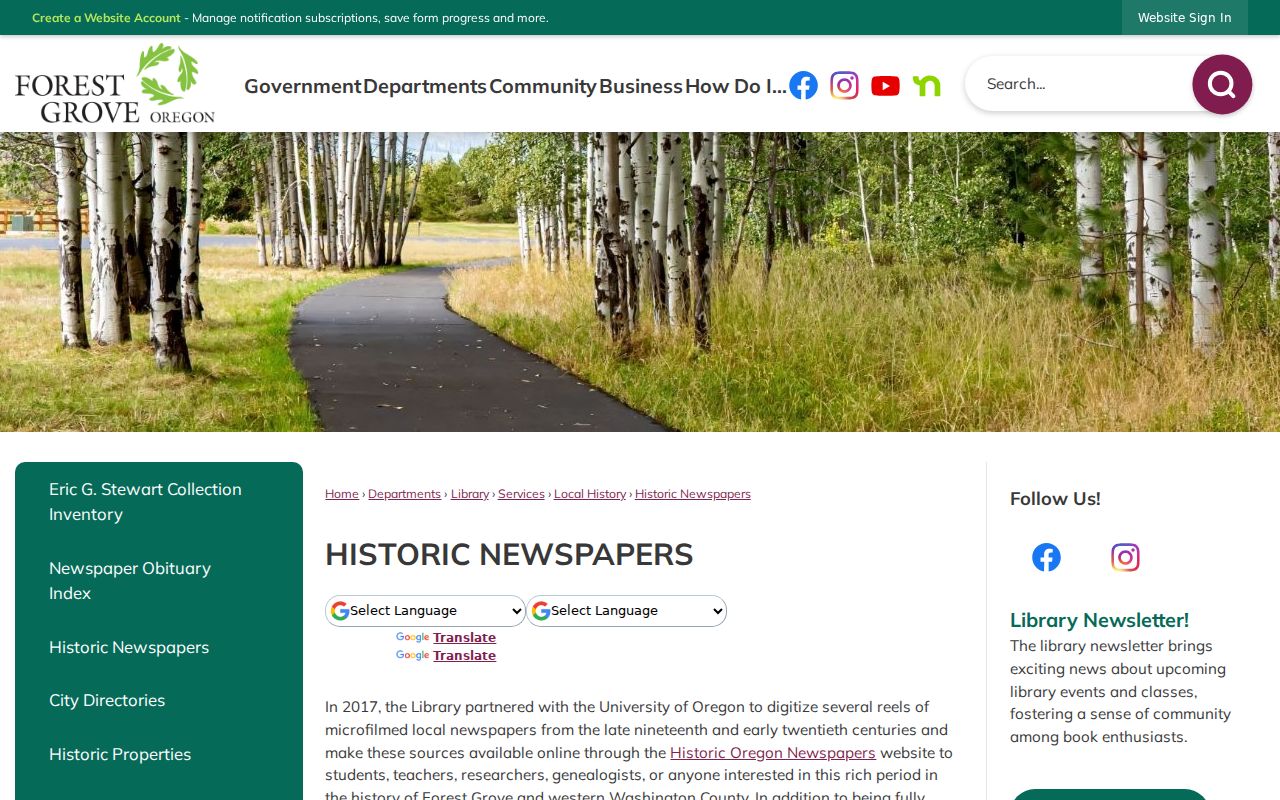
Newspaper mentions can identify a business, event, death notice, or construction date. They are time-specific evidence and do not prove that a person stayed at the same address.
Note: Match a newspaper result to the month and year of the nearest directory before joining the two records.
Forest Grove City Directories and Old Streets
Forest Grove street names changed twice, in 1892 and 1949, according to Friends of Historic Forest Grove research help. That matters when an address appears to vanish between a directory and a later tax, deed, or newspaper record. Before treating a failed search as a negative result, check whether the old street name was replaced. The same precaution applies to the central-city Sanborn maps, which cover the 1880s through the 1930s and may show building footprints, approximate property lines, and occasional occupant or store names.
The change history is also why an address should be paired with a person, a dated directory page, and a street name as printed. A modern address search can be useful for current property research, but it does not automatically resolve an older Forest Grove directory entry.
Trace Forest Grove City Directory Households
Use a directory as one layer in a household trail. The most reliable pattern is to begin with the best-known spelling and address, then make each later source answer a narrower question. A change in address may reflect a move, a renamed street, a variation in the listing, or a gap in the surviving run. Deeds and assessment records speak to ownership, while directories speak only to what was printed at a point in time.
- Find the earliest available Forest Grove name, address, telephone, or occupation entry and record its month, year, and page.
- Compare the next available directory or telephone item for changes in spelling, address, trade, or telephone detail.
- Search the digitized newspapers for the exact name and address, then try a surname variant.
- Check the 1892 or 1949 street-name change before rejecting an older address match.
- Use the historic-property or Sanborn context for a building question, then turn to Washington County records for a title question.
The federal census is a separate household snapshot. In 2026, 1950 is the newest released federal population census, so it can help bracket a mid-century directory finding but cannot fill later gaps.
For a present-day address trail, the separate Forest Grove street directory section focuses on the county's address-keyed records rather than rebuilding this historical shelf.
Forest Grove City Directory Obituary Index
The library's Newspaper Obituary Index has more than 39,520 entries. Its coverage is 1895 through 1920, January through June 1971, and January 1972 through December 2025. Entries can include surname, first name, nickname or alias, birth and death details when printed, and the date, page, and section of an obituary or death notice. The library adds entries weekly and refreshes the full index every two to three months.
The obituary index retains printed surname variants. Use the find command, try a four-digit year, and watch for a pre-1900 year prefixed with C, an approximate date marked c, or a printed error marked [sic]. An obituary can close a directory trail, but it should be compared with the source issue and any available family record.
Forest Grove City Directory Companion Archives
The directory shelf has strong local companions. The Eric G. Stewart Collection inventory includes church, business, historic-home, census, cemetery, biography, legal, and map material. It confirms a 1912 Sanborn-map item and cemetery records ranging from 1882 to 1992. Pacific University Archives adds annual catalogs from 1863 to 1999, Heart of Oak yearbooks from 1894 to 1996, The Index student newspaper, Pacific University People student directories from various years between 1948 and 1985, and alumni directories for 1983 and 1989.
Friends of Historic Forest Grove is another research route. Its museum and library occupy the former Southern Pacific Electric Train Depot at 1936 19th Avenue, with Wednesday hours from 10 to 1, Saturday hours from 1 to 4, and appointments available. The organization holds local-history materials, homesteading maps, photographs, and a research library.
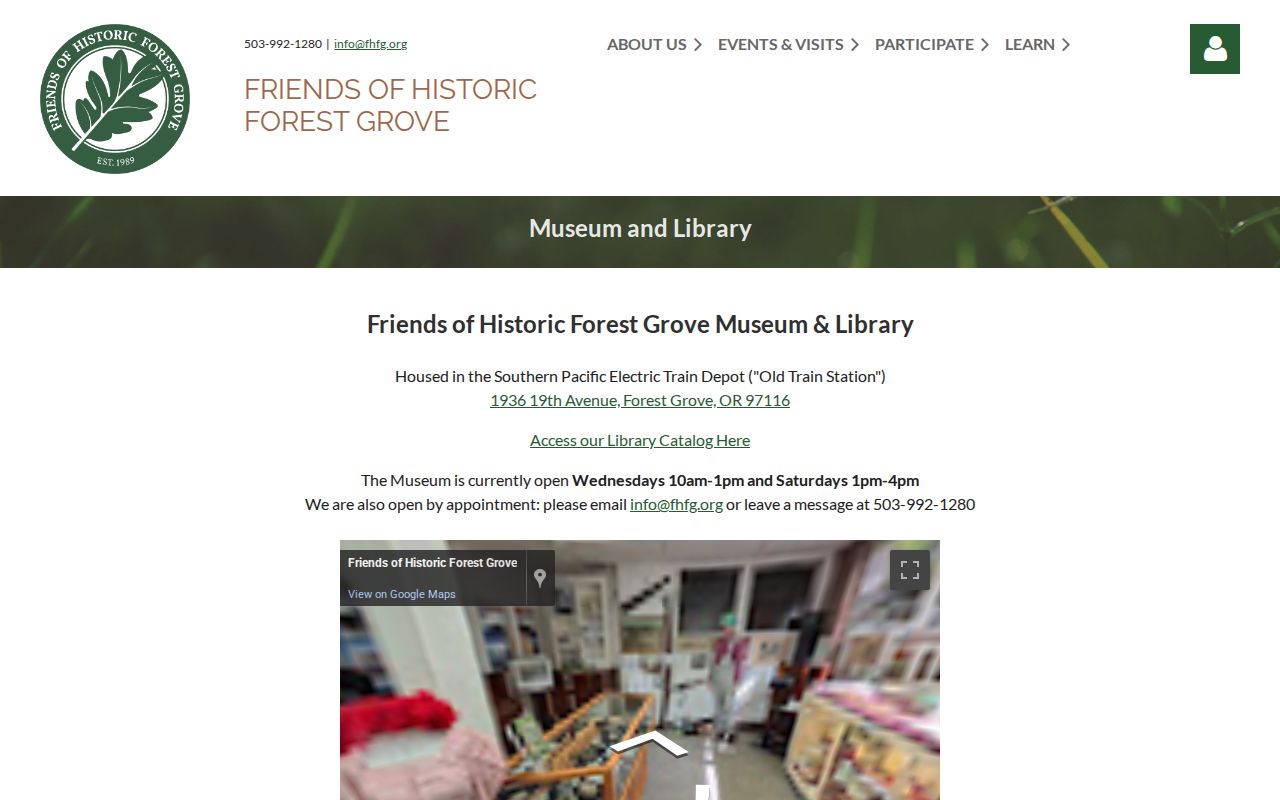
These collections can add context to a directory finding, especially when a household is tied to Pacific University, a historic building, a cemetery record, or an older map. They do not replace the library's dated directory evidence.